Bazaar
Meet pioneers in open source hardware and software!
Meet pioneers in open source hardware and software!
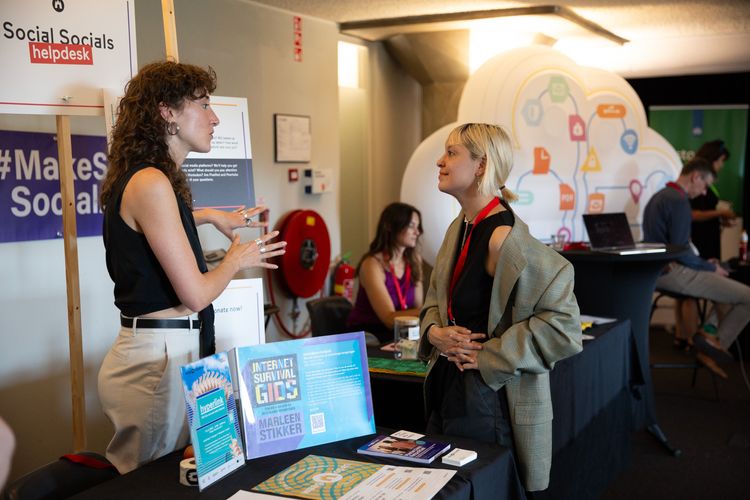
At this stand, you will explore what strategic digital autonomy means in your own daily work through visual exercises and conversations about possible future scenarios. You are invited to reflect on what digital autonomy means in your practice, which choices toward more digital autonomy you can make today, which ones feel blocked, and what trade-offs appear in the process. These conversations are part of an ongoing futures exploration by Lilian de Jong for Stichting Toekomstbeeld der Techniek (STT) about strategic autonomy around AI and data infrastructure in public governance. In return, you gain fresh perspectives, insight into how others approach similar challenges, and a clearer view of the choices shaping our shared digital future.
Publicroam provides a secure and user-friendly wifi network, ensuring a welcoming experience wherever publicroam is available.
Over 10 million people in the Netherlands regularly use public wifi, particularly in offices and public buildings. Almost any device can connect to it, it is free of charge, and it provides a fast and stable connection.
Convenience Finding out how to log in to a public network can often be a hassle. With publicroam, that is a thing of the past. You connect automatically at all affiliated locations. Register once, and you are online straight away.
Security Publicroam also improves security. Public wifi networks without a password, or with a shared password, are generally not secure, leaving visitors vulnerable to hackers. Publicroam ensures your data is properly protected through a personal account.
Simplicity More and more organisations want to offer good wifi access to their guests. Publicroam makes this straightforward, giving visitors a seamless experience that fits this digital age.
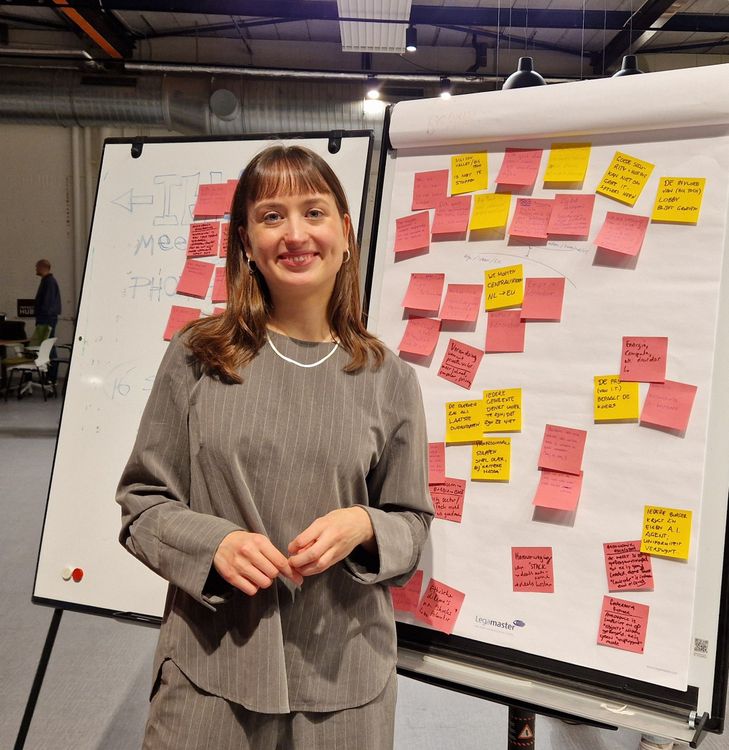
The challenges surrounding digital transition are not technical — they are about people. In organisations, digitalisation and artificial intelligence are often viewed through very different lenses, which means that policy development and collaboration frequently get off to a slow start. Welk AI Type brings these perspectives together with a surprisingly simple tool. Welk AI Type is an interactive, visual card game and analysis tool that gives teams insight into their attitudes towards AI. For better conversations, better decisions, and greater support within your team.

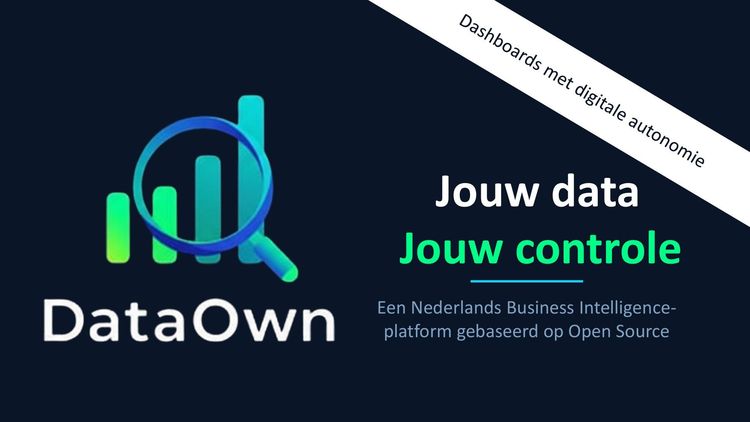
With DataOwn, you no longer need to invest valuable time in setting up complex data warehouses or dashboards. Our platform is intuitive, ready to use, and enables data specialists to focus on what really matters: serving internal clients. Whether it is building reports, analysing trends, or translating data into action — we take care of the technology, you create the impact. No endless menus of options, just what you need, ready to go. In a few clicks you can load a table incrementally or keep it up to date over time.
DataOwn gets you up and running so that within a few days you can build your own data warehouse tables, set up your dashboards, and get the most out of your data using the latest data science techniques. Would you rather outsource this? That is possible too — our BI specialists with over fifteen years of experience are ready to help.
DataOwn is built for today's world: data science and AI are an integral part. As a BI specialist, you are supported by AI when writing your SQL. As a user, you can ask questions of your data. As an analyst, you can run an explanatory or clustering analysis in no time.
In a world where data is the new oil, you cannot afford to be dependent on closed systems or Big Tech. DataOwn offers an open, European Business Intelligence SaaS solution that not only delivers insights, but also safeguards digital sovereignty. Our solution is built on open-source technology and runs entirely within the EU — so you always remain in control of your data, logic, and reports. Whether you are switching suppliers or looking to strengthen your own IT environment: with DataOwn you take not just your data, but also your logic and your dashboards with you.
DataOwn is more than a tool — it is a strategic choice. For organisations that place transparency, flexibility, and European values at the forefront. Whether you are a municipality looking to analyse citizen data securely, a healthcare institution wanting to share insights without dependencies, or a business that refuses to be fully reliant on a single supplier — with DataOwn you always remain master of your own data.
Ready for the next step? Discover how DataOwn helps your organisation take control of its data.
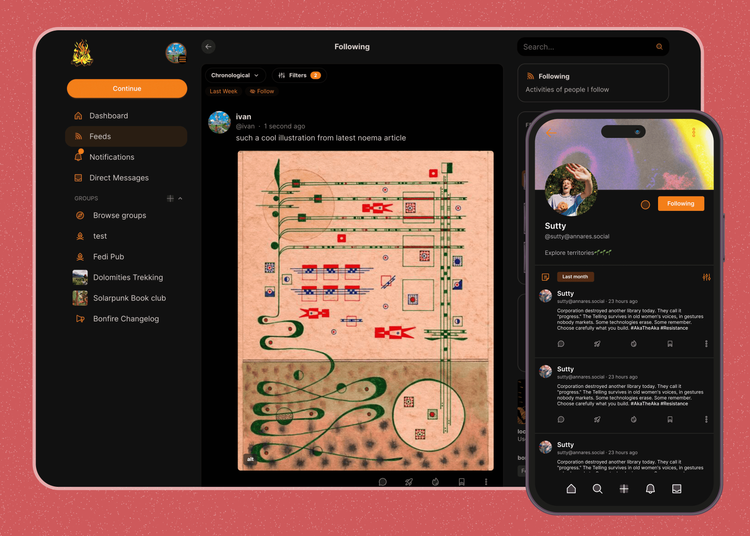
Bonfire is an open source framework for building federated digital spaces: modular, community-governed, and interoperable with the broader fediverse and bridged to ATProto.
We work with communities and organisations that want to move beyond extractive platforms and build their own digital infrastructure.
At the Bazaar we'll have a screen to show the platform in action and would love to talk with public broadcasters, libraries, healthcare institutions, educational organisations and local government bodies exploring alternatives to commercial platforms.
We all want to exchange digital data with each other safely and easily. Forum Standaardisatie helps make this possible by assessing open standards and prescribing them to public organizations. These standards improve cooperation between businesses, citizens, and the government. Forum Standaardisatie is an advisory committee composed of experts from various government organizations, the business community, and academia. The members are appointed in their personal capacity by the Ministry of the Interior and Kingdom Relations.
We are a collective of transdisciplinary dissenters of big tech platforms and platform capitalism at large, questioning the assumptions on how we build civic spaces and tools online.
Dyad, the first product we brought to market, is a steward-owned social network for conversations and community building in real life. We operate on principles of self-governance, reflected in our collective ownership and participatory governance models, and create ways for people, communities, and organizations to move from online interaction to offline connection through one-on-one and group conversations.
At the Bazaar, we'll showcase conversations that have taken place through Dyad, invite visitors to join the Amsterdam waitlist, and share our zine documenting our origins, ownership model, governance experiments, and vision for social technology as civic infrastructure.
We'd love to talk about steward ownership, democratic participation, digital commons, governance, biomimicry, and what it might take to create social technologies that remain accountable to the communities they serve.
The current digital educational system is dominated by tech giants. Fundamental rights, like the privacy, freedom, and sovereignty of children, parents, and educators are insufficiently secured. Ed-tech is mainly closed source and full of vendor lock-ins. Products are either overpriced, harvesting data, or both. The time to replace surveillance capitalist based Ed-tech by ethical open source alternatives is now.
All the open source building blocks to create a fantastic sovereign public-values-by-design school IT environment are already out there. All that needs to be done is work together with schools to integrate and test this open source software so that it aligns with the public values that this schools deem important. This is not as scary as one might think, together we can say goodbye to BigTech! More information.

Bring together perspectives on complex social issues and create a foundation for collaborative decision-making.
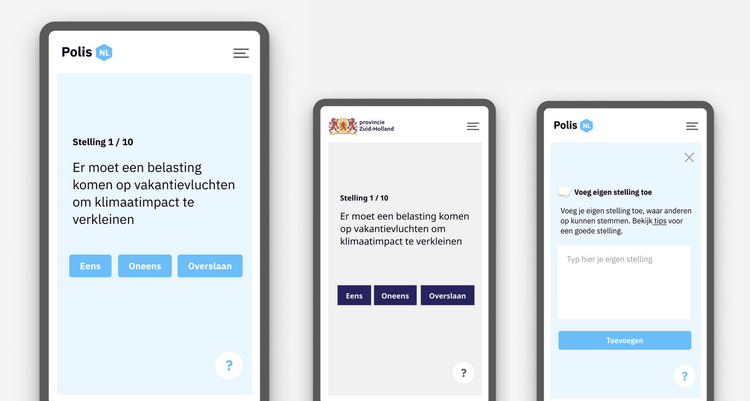
Polis is a participatory tool that allows thousands of people to engage in digital dialogue simultaneously. Using statements as a starting point, they explore a policy topic or issue.
Polis can be linked to in-person citizen deliberations or meetings to involve a broader group of residents in the conversation. The tool is also suitable for use with polarized issues. With the help of algorithms, Polis highlights where residents do agree with one another, rather than emphasizing their differences. The tool has been used for initiatives such as Stemmen uit de Samenleving en Praat Mee met de Overheid.
PolisNL is a partnership between government agencies. Together, we are working on a secure, responsible, and transparent adaptation of the open-source application Polis for the Dutch context. At the European level, the collaboration operates under the name Voxit; this name will also be used for the application in the future.